
Veteran-Owned | Licensed & Insured
CSLB #1108764 | DIR #1001134591
🕒 Estimated Read Time: 12 Minutes
This guide was built specifically for homeowners between Redding and Chico after seeing how often national pricing advice falls apart in North State conditions. We’ve included real project insights, climate data, and slab-specific considerations so you can make a decision based on what actually holds up here — not what works somewhere else.
The cheapest floor upfront is rarely the cheapest over 10 years — especially in Northern California heat and soil conditions. In Redding and Chico, what’s under your floor matters more than the material you choose.
Most flooring cost guides give you a price-per-square-foot chart and call it a day.
That’s useful if you live somewhere with moderate temperatures, stable soils, and straightforward subfloors. It’s less useful if you live between Redding and Chico.
Here, the floor you choose has to survive 99°F summer normals, occasional spikes past 110°F, clay-rich soils that expand and contract with seasonal moisture, and slabs that don’t always behave the way the installer expects. A national average doesn’t account for any of that.
This guide is built for North State homeowners who want an honest answer to the question: What will this floor actually cost me over the next ten years?
Before any price comparison means anything, you need to understand what makes this market different from everywhere else the guides are written for.
Redding’s normal daily maximum is 99.9°F in July. The city recorded 119°F on July 6, 2024. Chico has seen 110°F within recent station records. These aren’t worst-case scenarios; they’re what your floor lives in every summer.
The City of Chico requires geotechnical studies in areas with highly expansive soils. Shasta County’s design criteria allow the building official to require soils reports where conditions are questionable. Redding gravelly loam has documented expansive characteristics due to higher clay content. All of that means slabs here move more than slabs in more stable regions — and cost guides written for Sacramento or the Bay Area won’t tell you that.
North State slabs, especially in older homes, hold more moisture than the surface suggests. Moisture testing using ASTM F2170 in-slab probes — not surface tests — is the only way to know what’s actually happening inside the concrete before you coat or install over it.
South-facing rooms, open-plan interiors, and homes with large west-facing glass put floors under direct UV and heat stress that manufacturer warranties often don’t cover.
Before the material matters, three things do:
These are real-world ranges, not theoretical minimums. Actual costs depend on slab condition, room size, prep requirements, and system choice. Use this as a starting framework — not a final quote.
| Flooring Type | Install Cost (per sq ft) | Typical Prep Add-Ons | Maintenance (10 yrs) | Estimated 10-Year Total* |
|---|---|---|---|---|
|
Professional Epoxy |
$7–$13 |
$1,000–$5,000 (if needed) |
Low — periodic recoat possible |
Strong value on prepared slabs |
|
Polished Concrete |
$3–$12 |
Slab repair varies |
Very low — mop + neutral cleaner |
Best lifecycle on honest slabs |
|
LVP (quality tier) |
$4–$12 installed |
$150–$700 subfloor/transitions |
Moderate — section replacements possible |
Best for living areas, imperfect subfloors |
A fake-precision 10-year total doesn’t serve you. What matters more is which scenario below matches your actual space.
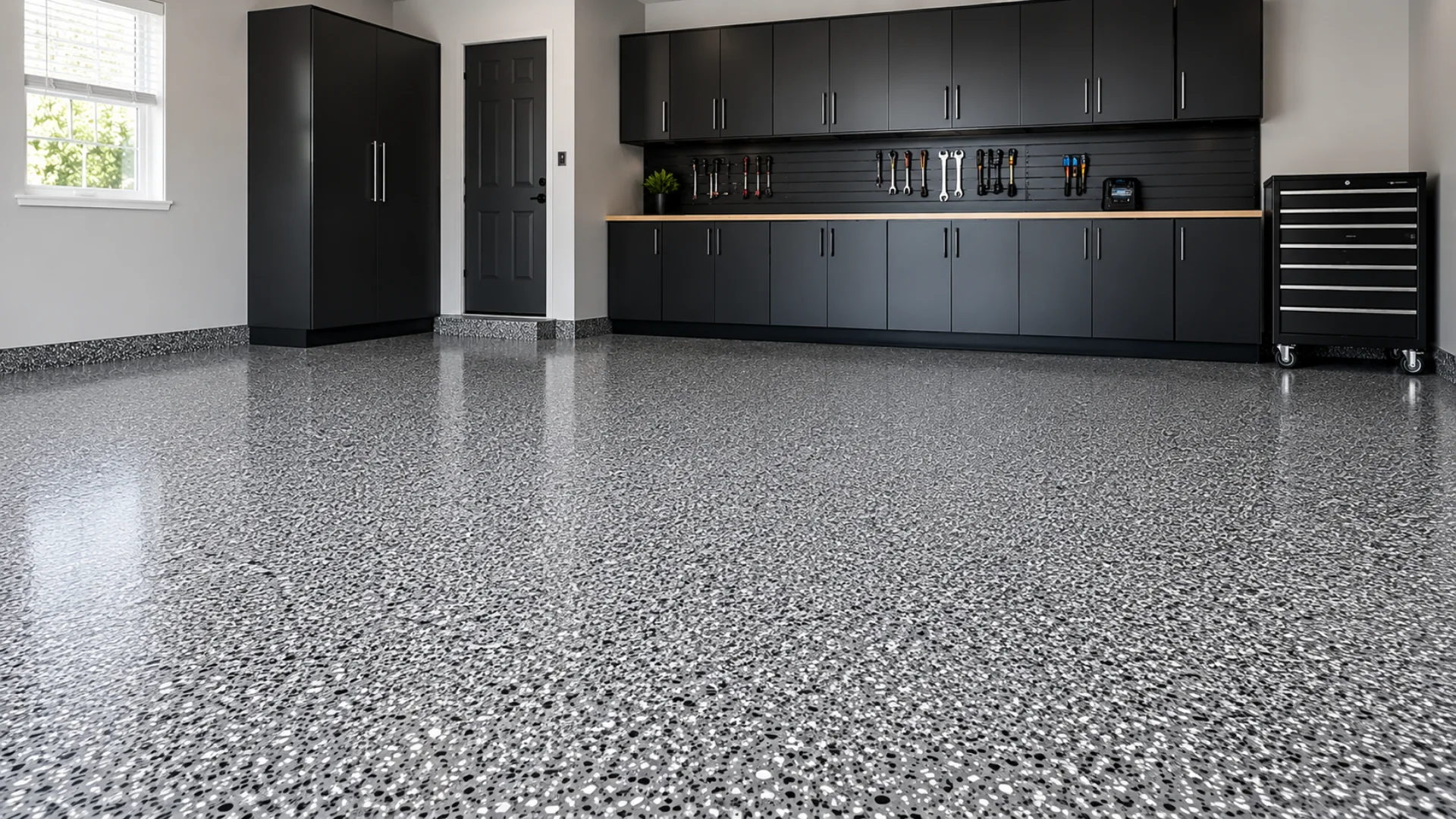
Best fit: Epoxy coating
If you have an existing concrete slab in a garage, workshop, or utility space and you want a finished, durable surface that’s easy to clean, professional epoxy is usually the strongest 10-year value in this category.
What it costs to install: Professional-grade 100% solids epoxy systems run $7–$13 per square foot under favorable conditions. A 2-car garage at 400–500 square feet typically runs $2,500–$5,500 all-in when the slab is in good shape.
What changes that number: Slab condition is the primary variable. Cracks, spalling, adhesive contamination, or elevated moisture levels all require prep before any coating goes down. In-slab moisture testing (ASTM F2170) measures what the surface can’t show you. Concrete repair and resurfacing can add $1,000–$5,000 before the coating begins. Diamond grinding — the correct way to prepare a slab — takes time and equipment. These are the line items that surprise homeowners who got a per-square-foot quote without a site visit.
What holds up in North State heat: 100% solids professional epoxy systems with UV-stable topcoats are built for covered garage applications in this climate. Where it gets complicated is direct sun. Epoxy coatings will discolor over time when exposed to sunlight, and even UV-resistant topcoats may not prevent underlying discoloration on fully exposed slabs. For protected garages and covered utility spaces — the most common application — UV-stable professional systems perform well.
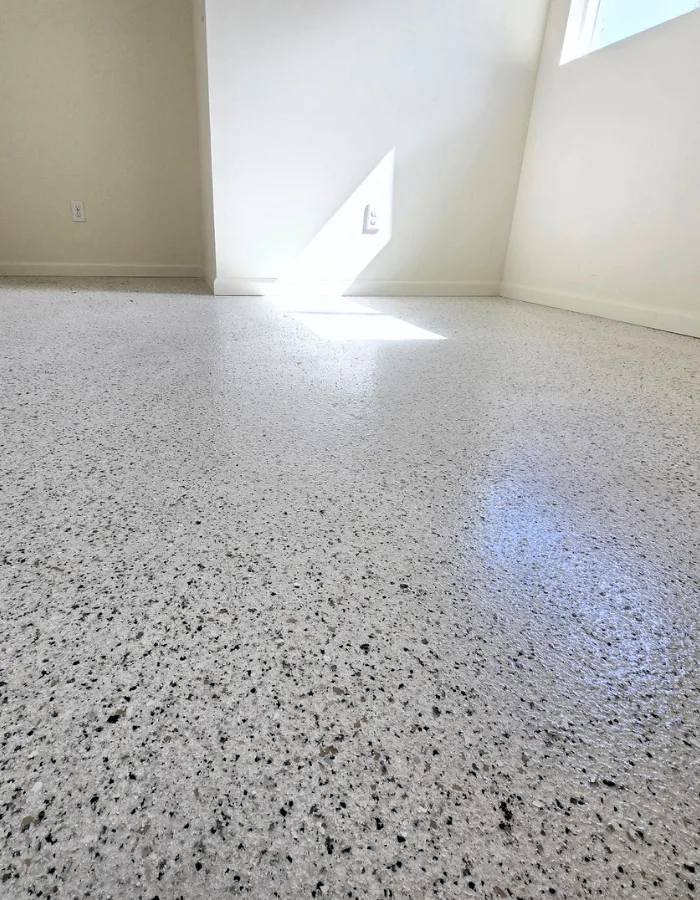
Comparing flooring options for your garage? See what a professionally installed epoxy system actually looks like in a North State home.
Best fit: Polished concrete
If the slab under your feet is structurally sound, polished concrete often has the most compelling 10-year value of the three options. It converts the concrete you already have into the finished floor — no added material, no adhesive, no underlayment.
What it costs to install: Polished concrete typically runs $3–$12 per square foot, with most projects clustering in the $4–$10 range for residential work depending on grinding passes and design choices. When the slab is clean and sound, it’s cost-competitive with epoxy on the front end.
The honest slab conversation: The American Society of Concrete Contractors notes that surface repairs before polishing are common — slabs frequently arrive with spalls, scratches, pinholes, and cracks that need addressing before grinding begins. In North State homes where expansive soils create seasonal slab movement, those repairs can be meaningful. This is a reason to have an honest site evaluation before comparing quotes, not a reason to avoid polished concrete.
Maintenance — the real advantage: Once it’s down and sealed, the Concrete Polishing Council’s technical guidance describes routine care as dust mopping and frequent mopping with a neutral cleaner. No waxing, no refinishing cycles, no replacing damaged planks. Over ten years, the maintenance cost profile is the lowest of the three surfaces for an interior slab application.
North State sun advantage: Polished concrete doesn’t yellow, fade, or delaminate from UV exposure. In rooms with significant direct light — south-facing living areas, sunrooms, open-plan spaces — this is a real advantage over coatings and vinyl.
Best fit: LVP
For occupied living spaces — bedrooms, living rooms, hallways, second-story rooms — where comfort, installation speed, and subfloor flexibility matter more than converting the slab, LVP is usually the most practical choice. It is not automatically the cheapest over time, but it is often the most accessible choice for the most common residential scenario.
What it costs to install: Quality LVP runs $4–$12 per square foot installed, with subfloor prep, demo, and transitions adding $150–$700 in most residential projects. Average lifespan for quality LVP is 10–25 years depending on wear layer and installation conditions.
What to watch for in a North State home: This is where the guide has to be specific rather than just helpful. Shaw Floors’ warranty language requires acclimation to 65°F–85°F before installation and specifies that post-installation damage from temperature control lapses may not be covered. Appearance changes from natural light and damage from plank movement caused by moisture, humidity, or temperature extremes are also listed as warranty exclusions. COREtec requires subfloor moisture testing and a climate-controlled environment even for products that don’t require traditional acclimation.
In a North State home that reaches 90°F+ inside before the AC kicks on, or a room with significant south-facing sun, those warranty exclusions are real variables — not fine print you can ignore.
Where LVP wins clearly: Upper-story spaces. Rooms where comfort and acoustics matter. Remodels on a timeline. Investment properties where value and ease of installation matter. In those scenarios, LVP is often the right answer — and a reputable contractor will tell you honestly when it is.
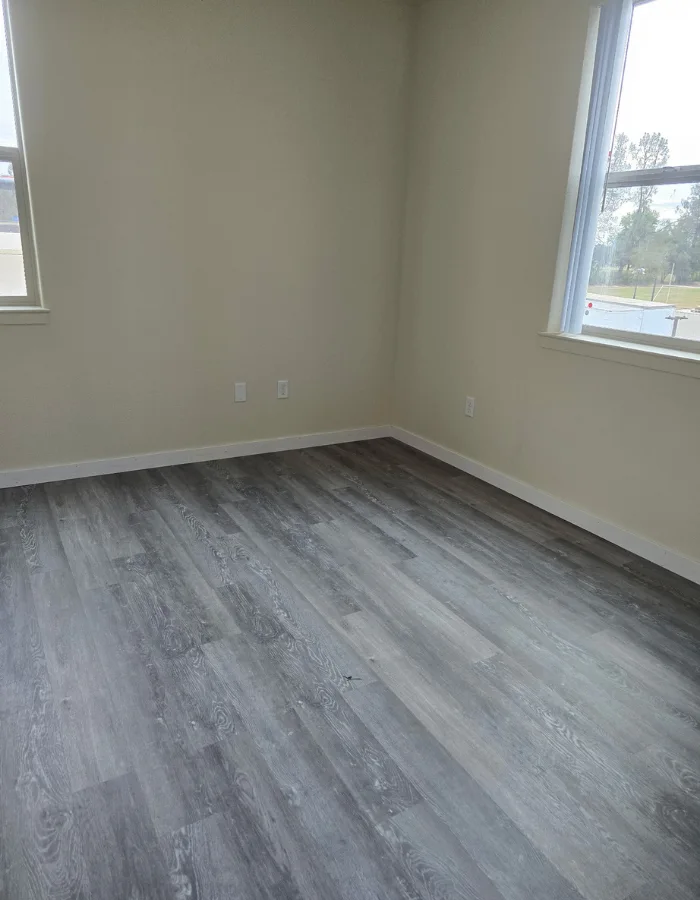
– Center of Hope Apartments Redding, CA
46,000 sq ft project | LVP | Subfloor: Gypcrete Floor | Final cost: $160,000
One of the most common concerns we hear before a project starts: “I’ve gotten quotes before that looked low and then changed.” Here’s the honest version of that conversation.
What can change your quote after the site visit:
What won’t change your quote: Once we’ve done a site visit and confirmed slab condition, moisture readings, and scope — the quote you receive from Simplicity reflects the actual work. No add-ons at the invoice that weren’t discussed at the estimate.
Why the site visit matters: A phone quote or a per-square-foot estimate without seeing the slab is a range, not a number. The most honest thing we can tell you is that the slab is the variable. We’d rather spend 30 minutes on-site and give you a real number than give you a low estimate that has to be corrected later.

The biggest cost mistake homeowners make is comparing flooring by price per square foot alone. In North State homes, slab prep, moisture levels, heat exposure, and long-term maintenance usually determine whether a floor lasts 3 years or 15.
It depends on your substrate and use case. For garage and utility slabs, professionally installed epoxy with proper prep is typically the strongest 10-year value. For existing interior slabs in good condition, polished concrete often has the lowest combined install-plus-maintenance cost over a decade. For living areas and remodels over imperfect subfloors, quality LVP is usually the most practical choice. There is no single winner — the substrate and room type decide it.
In a garage or utility space, yes — often significantly. A professional epoxy system on a properly prepared slab can last 10–20 years with minimal maintenance, while a comparable LVP installation in a high-traffic or vehicle-use area would fail prematurely because LVP isn’t rated for that environment. In a living room or bedroom, the comparison is closer and depends more on product quality, subfloor prep, and installation conditions than the material itself.
Yes, and the manufacturer warranties say so explicitly. Major brands including Shaw and COREtec specify temperature requirements for installation and exclude from coverage any damage resulting from temperature control lapses, direct sun exposure, and plank movement from heat and humidity changes. In North State homes with significant sun exposure or spaces that heat up before air conditioning catches up, those exclusions are worth reading before you install.
No. ASTM F2170 in-slab relative humidity testing measures moisture inside the concrete, not just at the surface. In North State homes — especially older slabs in Redding and Chico — elevated moisture is common and causes coating and adhesive failures when not addressed. The prep is what makes the floor last. Installers who skip it are the reason homeowners end up with peeling or bubbling surfaces within a few years.
Yes. Simplicity Flooring & Tile works throughout Shasta, Tehama, Glenn, and Butte Counties — including Chico, Red Bluff, Anderson, Corning, Cottonwood, Palo Cedro, and Shasta Lake.
Most homeowners contact us thinking they need a specific flooring product. By the end of the estimate, the conversation usually shifts to the slab itself.
Some homes in Redding have concrete that’s dry and stable enough for polished concrete with minimal prep. Others — especially older homes or properties near heavy clay soil — need moisture mitigation or crack repair before any floor goes down. We’ve walked into garages that looked perfectly fine on the surface but failed moisture testing underneath.
We’ve also learned that lifestyle matters more than trends. Families with dogs, river traffic, red dirt, or heavy shop use usually prioritize durability and easy cleanup. Other homeowners care more about warmth underfoot, acoustics, or keeping the house cooler during long North State summers.
That’s why we don’t push one “best” floor for every project. The right answer in Chico isn’t always the right answer in Redding, and the right answer for a garage isn’t the right answer for a living room.
A good flooring project starts with an honest conversation about how you actually live in the space.
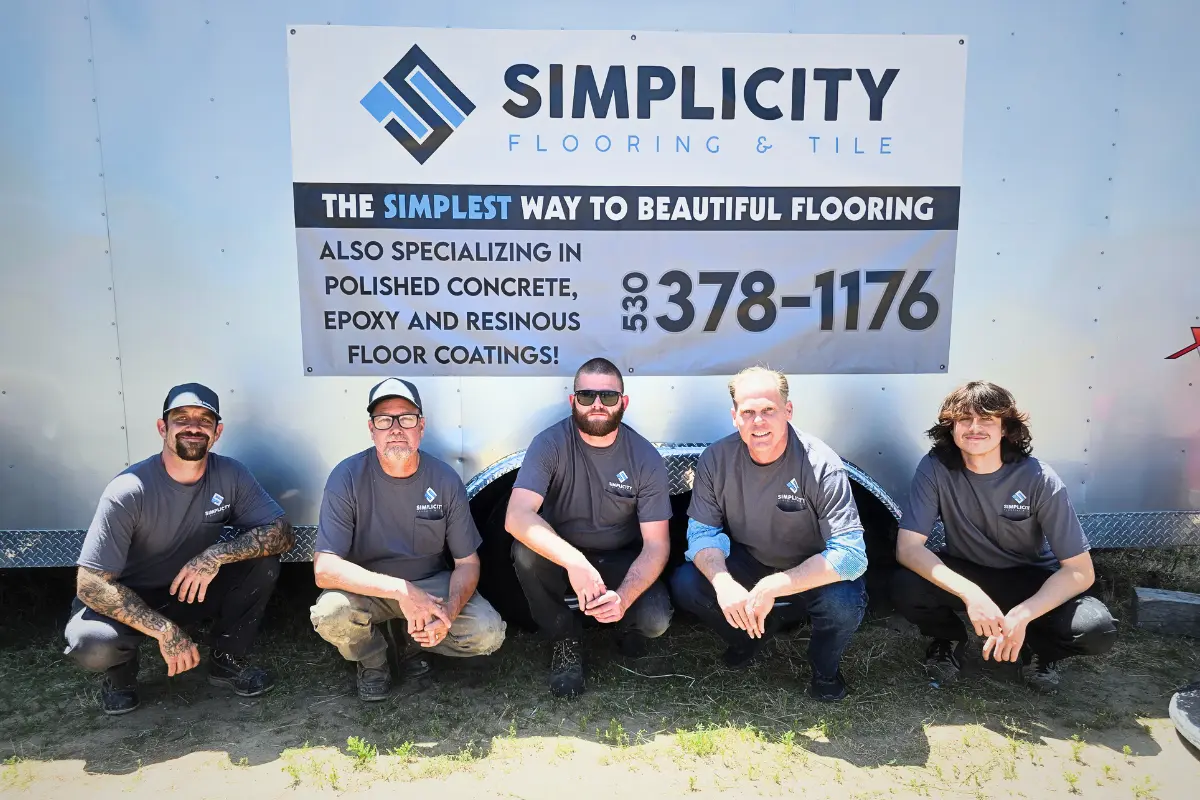
Every estimate we give starts with a conversation — not a sales pitch. We ask about your space, how you use it, your timeline, and your budget. If a mid-range product does the job as well as the premium one for your situation, we’ll tell you that. We’d rather have a customer for life than a bigger invoice today.
Even if you’re still comparing options, it costs nothing to get a real quote from Simplicity Flooring & Tile in Redding, CA. We’ll look at your space, tell you honestly what it needs, and give you numbers you can actually compare — no pressure, no upsell.
📞 Get a Free Quote Today or stop by our Redding showroom to see polished and stained concrete samples side by side.
Serving homeowners across Redding, Anderson, Chico, Cottonwood, Red Bluff, Palo Cedro & Shasta Lake.